
Showing posts with label Inscriptions. Show all posts
Showing posts with label Inscriptions. Show all posts
17 July 2010
XIII
07 September 2008
Itineraries
Our site of the Vicus ad Martis Tudertium shows up not only in some inscriptions (see this earlier post), but also in a few ancient and medieval itineraries, which are basically a kind of simple map for trips. Instead of representing the world in a more or less accurate two-dimensional image, itineraries are lists of places along a given route with the distance between each place given in Roman miles. (Of course you can combine these with what look to us more or less like maps, and then you get something like the Peutinger Tablet.)
Thanks to the internet tubes, several of these itineraries are available on-line:
Thanks to the internet tubes, several of these itineraries are available on-line:
- The Itinerarium Gaditanum ("Cadiz Itinerary") - in which "Martis" or "ad Martis" can be found near the end of the list, 16 (or 17 in one case) miles from Mevania (modern Bevagna) and 17 (or 13 or 18) miles from Narnia (yes, Narnia).
- The Tabula Peutingeriana ("Peutinger Tablet") - which is a distorted 2-D map with a number of itineraries put on it in a kind of semblance of geographical reality. (You can search for other versions too.) To find "ad Martis", scroll all the way to the right in the image I've linked to. You'll see Roma there, as a seated figure in a biggish circle. Can't miss it. Above Roma's head is a largish, red letter "A" and a bit above that an "M." Go left from the "M," to "U" then "N" then "E" then "C" (keep going and you'll get "Picenum" backwards). Under the "C" is one bit of writing. Ignore it. Under that, you'll see "vii ad Martis xvi." Careful observers will note that the next stop on this itinerary is neither Mevania nor Narnia.
- It's also in the Antonine Itinerary, but I can't find an on-line version of that.
- The stupid Bordeaux Pilgrim skipped us on his way from Rome to Milan, and took the eastern branch of the Flaminia.


26 August 2008
Pottery Stamps
Over the course of the summer, we found three pieces of terra sigillata marked with stamps.

First, an intact "CV" (closest to OCK 2275.5, AD 25-50, but with less space between the letters and the border of the enclosing rectangle):

Second, a partial stamp, showing the last two letters of "L.N.P." (OCK 1226.14, 15 BC - AD 5). The inital "L" seems to have been lost in the ridges (i.e., the stamping was poorly done):
 Finally, the longest of the three, a "Surisc[us] | L. Non[i]" where the "u" and the "r" of "Surisc" run together in a "VR" ligature (OCK 1282.2, 10 BC+):
06 June 2008
Inscription
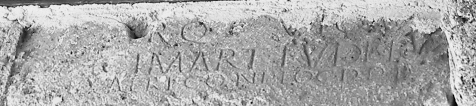
Well, as expected, all three inscriptions are in the CIL ("Corpus Inscriptionum Latinarum") volume that deals with this part of Italy, XI. Here's a photo of the inscription that gives the name of the site. I had to play with it a bit to get it to be readable (ok, mostly readable), so it appears to be in black and white, though it isn't. You can make out in the big second line "MART. TUDE" which is the middle of "Vicus Martis Tudertium", that is, "Settlement of the Mars of the people of Todi."
Sunday we plan to start the geomagnetic survey, in collaboration with Tomaso Mattioli from the University of Perugia. Should be good.
Someday the big trailer will arrive from the local town ('nuff said, if you know about Italian bureaucracy and work habits).
04 June 2008
Arrivato!
I arrived Sunday in Italy without incident, despite the massive thunderstorms on the East Coast during the day.
Spent the day with my colleague Carlo Zoccoli, visiting a few places, including the site of the excavations where we observed a few inscriptions embedded in the wall of the medieval tower next to the church. Two have been published already, but perhaps not the third.
The first is over the small door to the tower and reads:
PỌḄḶỊCIA·A·L·
SALVIA
The other two were noted by Becatti back in the 30s and include one of the inscriptions that mentions the place by name.
Today's lesson: Always Bring the Camera
Subscribe to:
Posts (Atom)