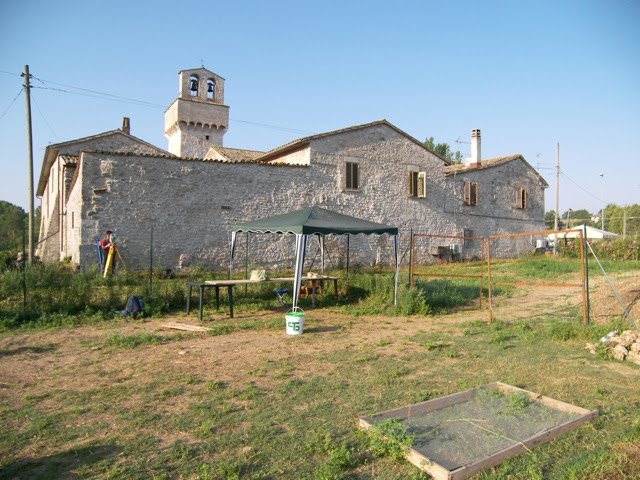
14 July 2010
Finally!


05 July 2010
Vicus vBlog 4
Here's another installment of video showing a bit of what goes on when we're not on the site. Enjoy!
01 July 2010
Laura learns a new Italian word: Parrucchiere

UPS student Laura Hollister has been practicing her Italian in the trenches, but today she went native and got her hair cut. First time it's been short since she's been three, she says. You never know what'll happen.
26 June 2010
First Session Ends!
Despite a short train strike yesterday, it seems that the students from the first session were able to make it to Rome and most should now be at the airport awaiting their flights. Rangar and his wife Jen and daughter Poppy are safely on their way to Perugia and thence to Florence, and Sarah is down at a conference at the Villa Vergiliana in Cuma...which leaves me in Massa, trying to keep up with the blog!

We had a terrific first session. Some interesting finds, lots of topsoil removed to expose more (and more!) walls, good food and new friendships. Here's our "official" end-of-session group photo at the right. (Clicking on it will bring up a larger size.)
High- and low-lights of the session include finding a second burial (mostly destroyed before we got to it), a few wonderfully preserved coins, France and Italy falling out of the World Cup (and USA and Portugal making it!), the annual party at the Massa Martana circolo (with the usual karaoke performances), our first dig volunteers, Pam and Gordon Mettam (on whom more later), terrific weather with only one rain day, and trips to Ponte Fonnaia, the catacombs, Carsulae, Perugia, Todi, Rome and elsewhere.
Some other photos, in no particular order:


We had a terrific first session. Some interesting finds, lots of topsoil removed to expose more (and more!) walls, good food and new friendships. Here's our "official" end-of-session group photo at the right. (Clicking on it will bring up a larger size.)
High- and low-lights of the session include finding a second burial (mostly destroyed before we got to it), a few wonderfully preserved coins, France and Italy falling out of the World Cup (and USA and Portugal making it!), the annual party at the Massa Martana circolo (with the usual karaoke performances), our first dig volunteers, Pam and Gordon Mettam (on whom more later), terrific weather with only one rain day, and trips to Ponte Fonnaia, the catacombs, Carsulae, Perugia, Todi, Rome and elsewhere.
Some other photos, in no particular order:


23 June 2010
Vicus vBlog 3 (courtesy of RAI 3)
Italy's third national channel came to the site last week to do a piece on us. See if you can figure out which part is staged. :-)
21 June 2010
Rain!

After a very wet winter and spring, we were doing pretty well in Umbria, even as north Italy was getting pounded with heavy rains and flooding. That ended this weekend, as the rains hit on and off, finally settling on "on" most of this morning, with the result that we took a break from digging.
After the sun made a brief appearance this afternoon, I planned a quick trip down the Via Flaminia to visit Carsulae and get an update from Prof. Jane Whitehead on their first day of excavation. Carsulae is a little south of us (about 20 minutes by car) and somewhat up in the mountains, so the weather is a bit different...and we managed to find some rain there.
Bottom line: I got to run my first forced-march across an archaeological site in inclement weather. Nothing like the infamous Centro Attack on Pompeii, led by Prof. Paul Harvey in Spring '86, but I do what I can. We ended up damper and slightly worse for wear, but wiser for our experience of the "Pompeii of Umbria."
The forecast for the rest of the week is better, with no rain and highs only in the mid-80s.
16 June 2010
Coins
As in past years, we're finding a good number of coins again this year, exclusively Roman bronze issues so far. Coins are always fun to find, but yesterday we came upon a pair of coins in a "good" stratum, that is, a stratum of soil that lies below the plough zone and which we can place in relationship to other layers and structures on the site (like a wall or floor, or another stratum of soil). This means a lot more to archaeologists than how well preserved the coins are, because it allows us to use the coins to say something about the history of the site, instead of only admiring them for how nice they look (which is also enjoyable).
What was interesting about these two coins is not only that they were found close to one another (about 20 cm apart), but also that they date to approximately the same time (AD 230s and 240s) and that the later one is in remarkably good condition, so little worn that it could not have been in active circulation for very long.
 It's a sestertius of Phillip "the Arab," emperor of Rome in the 240s, who was lucky enough to celebrate the 1000th birthday of the city (21 April 248). Here's an image, which is not as sharp as it might be, but which still shows amazing detail in the hair and eyes. You can perhaps read the inscription, which runs from about 7 o'clock, around over his head clockwise: "IMP M IUL PHILIPPUS AUG."
What was interesting about these two coins is not only that they were found close to one another (about 20 cm apart), but also that they date to approximately the same time (AD 230s and 240s) and that the later one is in remarkably good condition, so little worn that it could not have been in active circulation for very long.

Subscribe to:
Posts (Atom)